
State of Australian SME Report – September 2025 Edition
- Home
- Articles
- Benchmarking Advice
- State of Australian SME Report – September 2025 Edition

Our September update of the State of Australian SME Report looks at what’s shaping SMEs in Australia right now. We bring together the latest data on turnover, confidence, monetary policy, and industry challenges to give a clear view of the current landscape.
This report is designed to equip advisors working with SMEs with practical insights they can take into client conversations—helping businesses plan budgets, manage risks, and position themselves for growth.
This month, we’ve also included an overview of state-based export programs, alongside a summary of where the RBA sees the economy heading and what that means for SMEs.
Read on for all the details, or jump ahead here:
The Numbers: What The Data Tells Us About Recent Business Performance
The latest Monthly Business Monitor from the Australian Bureau of Statistics (ABS) reported a 2.9% rise in business turnover in seasonally adjusted terms. This is the largest monthly gain since May 2022.
What’s particularly exciting for the economic outlook is that every industry division tracked by the Monthly Business Turnover Indicator contributed to this upswing. This shows broad-based momentum, not just one industry surging.
That said, recent months have shown fluctuations, and it will take the next few releases to confirm whether this is the beginning of a sustained upward trend.
Quick notes for advisors:
- Strongest gain in over three years: A 2.9% lift signals renewed activity, with SMEs, particularly those operating in B2B markets, well positioned to capture future opportunities.
- Uptick across all sectors: The across-the-board increase suggests structural support for growth, not just a rebound in selective industries.
- Contrast in performance: The sharp swing from May’s flat patch to July’s strength creates an opening for renewed client discussions on growth initiatives or rethinking previously cautious plans.
Confidence: How Are Businesses And Consumers Feeling?
Business confidence: from cautious optimism to cautious pessimism.
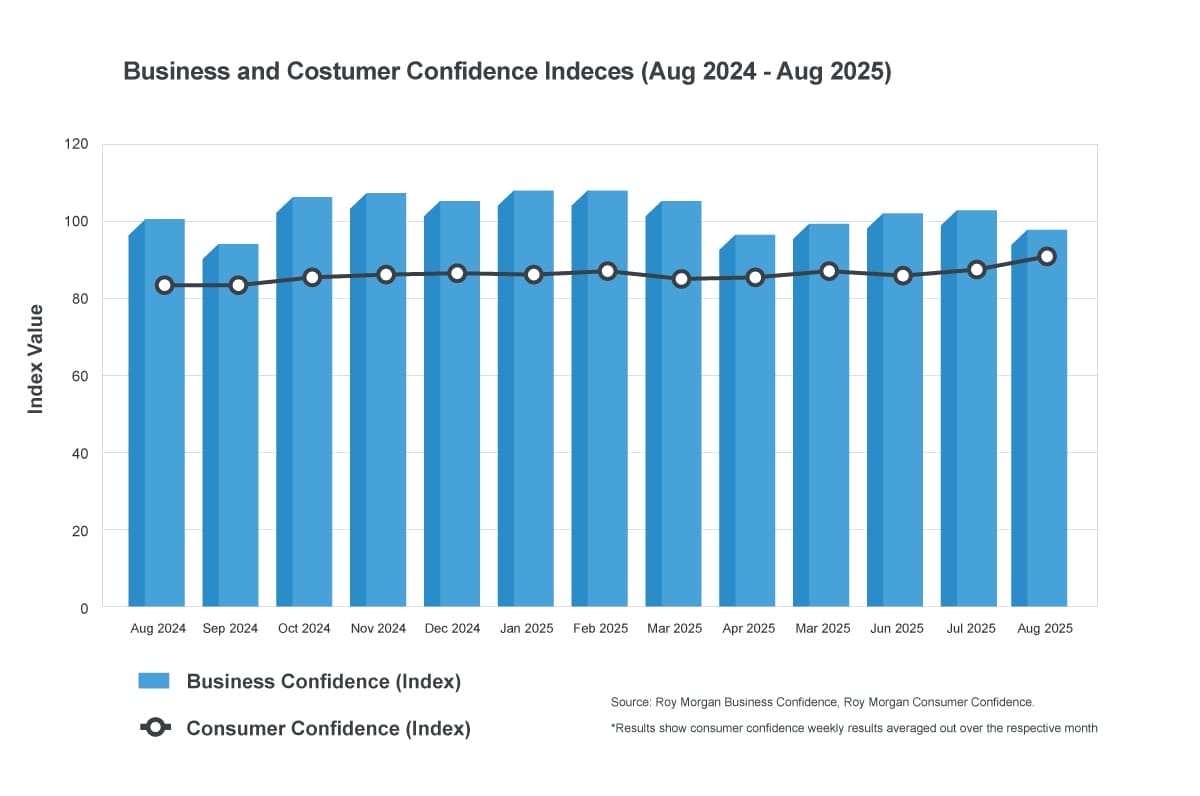
Business confidence slipped in August 2025, falling 4.4 points to 98.6 on the Roy Morgan scale. This is its lowest level since April. This decline pushed confidence back into negative territory despite supportive conditions such as the Reserve Bank’s August rate cut and the ASX200 reaching record highs.
The decline is driven by business owners concerned about the year ahead: fewer businesses expect to be financially better off in 12 months (39.6%, down 1.3 points), while more now anticipate being worse off (24.3%, up 4 points).
Owners are also less confident in the broader economy. Just 57% of businesses expect “good times” in the next year, the lowest reading this year, while 40.4% anticipate “bad times.” Overall, confidence remains 11.4 points below the long-term average of 110, although it is still stronger than consumer confidence, which sits at 89.3.
What does this mean?
With reduced confidence, businesses may become more cautious in their spending. However, this climate also creates opportunities for advisors to add value. Helping clients review their FY26 budget forecasts and business plans can provide clarity, guide decision-making, and encourage targeted strategic investments that support sustainable growth.
Consumer confidence: rebounding slowly, but surely
In early August, consumer confidence pushed above 90 for the first time in three years. In the first week of September it eased slightly, sitting at 89.3.
Despite this dip, when viewed monthly, the trend continues upwards. Further, it now sits 7 points above the same time last year, signalling a slow but steady recovery in household sentiment.
Interestingly, consumers felt fairly similar to businesses regarding the outlook for personal finances over the next 12 months. Nearly 29% of Australians expect their family to be better off financially a year from now, which is the highest net rating since April. This is compared to 27% who expect conditions to worsen. Unlike business owners, this sentiment has improved, contributing to the gradual lift in consumer confidence rather than the decline seen in business confidence.
Spending intentions remain sober. Just over a quarter (26%) of households say it’s a good time to purchase major items, while 35% believe it’s a bad time. This shows there is still ongoing caution around discretionary spending.
For businesses, the key takeaway is that households are gradually regaining confidence in their own finances, but remain wary of broader economic risks. Businesses should plan for steady demand in essentials, while discretionary sectors need to prepare for a slower recovery curve.
Deep Dive Into The RBA Outlook: And, What It Means For Smes And Their Advisors
This month our deep dive article looks at the Reserve Bank of Australia’s (RBA) August 2025 Statement on Monetary Policy. The report highlights a cautiously optimistic economic outlook, tempered by persistent challenges that directly affect small and medium businesses. For accountants and consultants working with SME clients, understanding these points can help guide cash flow strategies, investment decisions, and risk management. Below are some of the key areas of interest for business owners and their advisors:
1. Inflation is easing but remains above target.
The RBA expects inflation to return to the 2–3% band by mid-2026. While pressures are softening, energy and housing costs remain sticky. For SMEs, this means cost pressures are easing but not disappearing.
2. Interest rates likely to remain restrictive in the near term.
Even with a recent 0.25% cut, rates are expected to stay elevated longer than many hoped. Most analysts predict only one further cut in 2025 and limited movement in 2026. While high rates add to debt servicing costs, their relative stability provides an opportunity to revisit financing plans and explore refinancing options.
3. Slowing but positive economic growth.
The RBA projects GDP growth of around 1.75% in 2025. It’s below target, but still positive. For SMEs, this points to modest demand recovery, particularly in services and construction. As noted earlier, business turnover is also increasing, and with GDP on the rise this could signal new opportunities for business owners.
4. Labour market softening.
Unemployment is expected to rise to around 4.5% by 2026. Wage growth is easing from its peak but remains above pre-pandemic averages. For SMEs, this may ease recruitment pressures, but margins could still be tight. Advisors can help clients assess workforce productivity and weigh staff expansion against investing in new tools and systems.
5. Consumer demand remains fragile.
High household debt and cautious consumer sentiment mean discretionary spending is likely to remain low for the foreseeable future. SMEs in retail, hospitality, and personal services have already felt the impact and may continue to. That said, with consumer confidence slowly rising, these industries should begin to see customers return over time.
6. Global uncertainties remain a headwind.
Geopolitical tensions, supply chain risks, and slower Chinese growth continue to cloud the outlook. SMEs with international exposure should investigate options for diversifying markets and suppliers.
How can you add value for your clients?
- Budgeting & forecasting: Use benchmark reports to build realistic budgets and highlight where clients can improve efficiency.
- Capital planning: Guide clients on timing investments to align with conditions expected to ease from 2026.
- Debt management: Explore refinancing, fixed vs. variable rate mixes, and strategies to reduce reliance on high-cost debt.
- Workforce planning: Support clients with strategies to maintain efficiency as labour markets ease.
- Strategic resilience: Help SMEs diversify, strengthen supplier relationships, and prepare for external shocks
Risk Landscape: Sectoral Challenges and Insolvencies
Australia’s business risk environment remains highly dynamic, with conditions shifting across industries. The latest CreditorWatch report shows that July brought an uptick in B2B invoice defaults, breaking the run of recent improvements. While not dramatic, this serves as a reminder that financial stress is still present in parts of the SME sector.
Insolvency patterns: distress building in key sectors
Insolvency levels remain higher than pre-pandemic averages, but the latest data is best read as a reminder that pressure points still exist rather than a sharp downturn. July recorded a 5% rise in B2B invoice defaults, and year-on-year levels are trending higher, suggesting some SMEs are managing tighter cash flow. Because defaults often precede insolvency, this is a useful signal for advisors to monitor when guiding clients.
Construction continues to lead insolvency figures, particularly among small subcontractors navigating delayed payments and slim margins. Retail and food services are also feeling pressure as households remain cautious in their spending, though gradual improvements in consumer sentiment provide some encouragement.
Shifting Risk Profiles
Some industries traditionally viewed as stable are showing emerging challenges. Healthcare providers are managing funding and cost imbalances, education operators face enrolment pressures, and discretionary retail remains vulnerable. These shifts highlight the importance of staying proactive with monitoring and advice.
At the same time, Small Business Restructuring (SBR) processes are being adopted more widely. Nearly one in five insolvencies in FY25 used SBR, reflecting its growing role as a structured pathway for stabilisation and recovery rather than purely a last resort.
Supporting Business Owners
For advisors, recognising the early signs of financial distress is essential to helping clients act before problems escalate. In higher-risk industries especially, proactive engagement can make a significant difference. Practical strategies include:
- Payment behaviour analysis: Track debtor and creditor trends to identify stress points early.
- Enhanced monitoring: Combine benchmarking with regular cash flow reviews to spot vulnerabilities in advance.
- Sector‑specific insights: Prioritise clients in Construction, Retail, Healthcare, and Education where stress signals are most evident.
- Restructuring pathways: Help clients explore options such as SBR to manage risks and preserve viable businesses.
- Exit planning: For owners considering stepping away, a business valuation can provide clarity on readiness and positioning.
This balanced approach ensures that while risks are acknowledged, the emphasis remains on supporting SMEs to stabilise, adapt, and prepare for recovery.
Government Support & Grants: Focus on Export Assistance Across Australia
For SME clients engaged in exporting—or planning to—understanding available government support is essential. The flagship Export Market Development Grant (EMDG) program has changed in recent years, making it harder for some businesses to access. However, state and territory governments continue to provide valuable assistance.
Across Australia, programs currently on offer include grants, training, trade missions, and advisory services designed to help businesses expand internationally. Below is a snapshot of active programs by state and territory:
➤ Australian Capital Territory (ACT)
The ACT provides export readiness workshops, an annual Export Day, and government-led trade missions. Businesses can also access one-on-one advice through the local TradeStart adviser.
Program Info: https://www.act.gov.au/business/grow-your-business/export-to-new-markets
➤ New South Wales (NSW)
NSW supports exporters with free capability workshops, TradeStart advisers, and the Going Global Export Program, which combines coaching with trade missions to connect SMEs with overseas buyers.
Program Info: https://www.nsw.gov.au/business-and-economy/export-from-nsw
➤ Northern Territory (NT)
The NT backs exporters through its Global Trade Scheme (grants up to $50k) and TradeStart advisers. Businesses can also join trade missions and access training to build export capacity.
Program Info: https://nt.gov.au/industry/business-grants-funding/global-trade-scheme
➤ Queensland (QLD)
Trade & Investment Queensland (TIQ) provides free export advice, workshops, and trade missions. With representation in 16 countries, TIQ connects Queensland exporters with international markets and buyers.
Program Info: https://www.business.qld.gov.au/running-business/marketing-sales/sales/exporting-basics/export-support
➤ South Australia (SA)
South Australia offers dedicated export advisers, co-funded grants (e.g. SA Export Accelerator and Global Expansion Program), and sector support programs such as seafood and wine initiatives.
Program Info: https://export.sa.gov.au/
➤ Tasmania (TAS)
Tasmania supports exporters with Accelerating Trade Grants (up to $10k), advanced manufacturing grants, and regular outbound trade missions. Assistance is coordinated through Trade Tasmania.
Program Info: https://www.stategrowth.tas.gov.au/grants_and_funding_opportunities/grants/accelerating_trade_grant_program
➤ Victoria (VIC)
Global Victoria delivers trade missions, export skills programs, and advisory support through 23 trade offices worldwide. The agency helps Victorian businesses build capability and expand into global markets.
Program Info: https://global.vic.gov.au/
➤ Western Australia (WA)
WA supports exporters via Invest and Trade WA, offering advice, global office connections, event funding, and showcasing opportunities at major international trade shows and missions.
Program Info: https://www.dpird.wa.gov.au/businesses/trade-and-investment/exporting-from-wa
Leveraging this info for your clients
Advisors have a key role in helping SME owners respond to current and future opportunities and challenges. If you’re working with SMEs, here are four practical steps you can take today to support your clients in the current climate:
- Review cash flow forecasts: Stress-test assumptions against fluctuating confidence and spending trends to ensure businesses are prepared for different scenarios.
- Revisit financing strategies: With interest rates steady but high, help clients evaluate refinancing options and debt structures.
- Benchmark performance: Use benchmarking reports to identify gaps and opportunities, giving clients clarity on where they stand against peers.
- Plan for resilience: Work with clients to strengthen supplier networks, explore export opportunities, and build strategies that account for global and local risks.
Want to explore how you can support your clients further? Get in touch with our team to see how we can help.